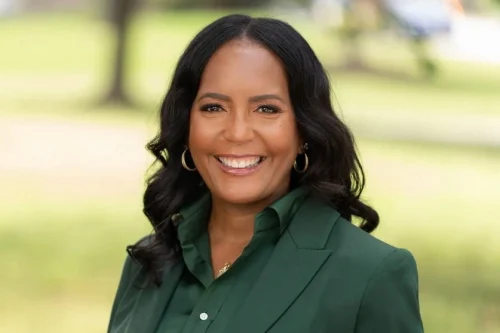
Yvonne Bajela Closes $17 Million Debut Fund to Back AI and Fintech Startups
November 5, 2026
British-Nigerian law professor Dapo Akande has been elected to the International Court of Justice (ICJ), becoming the first British judge to join the court in nine years.
He stood as the United Kingdom’s sole candidate and secured the required majorities in both the UN General Assembly and the Security Council. His election restores Britain’s representation on the 15-member World Court after nearly a decade without a UK judge.
Related Post: 9 British-Nigerians Making Their Mark Across UK Culture and Business
Dapo Akande’s Emergence as a UK Judge to the ICJ
The UK Foreign, Commonwealth and Development Office confirmed Akande’s election on November 3, following a campaign backed by British ministers and diplomats. He will begin his nine-year term in The Hague on February 6, 2027.
The UK Government campaigned extensively for his election, and his candidature attracted 43 nominations from national groups across UN regions. During the General Assembly debate on October 29, British Justice Secretary Alex Norris praised Akande’s professional qualifications and independence. “He would make a formidable contribution to its work,” Norris said as he presented Britain’s case for his election.
Akande was among four candidates who secured the required majorities in both UN organs during the first round of voting. He reportedly received 11 votes in the 15-member Security Council, above the eight votes required for election. The Nigerian-born law scholar was elected alongside four other candidates: François Alabrune of France, Mahmoud Daifallah Hmoud of Jordan, Rena Lee of Singapore and Phoebe Okowa of Kenya.
Nine candidates contested five positions during the election. While four candidates secured the required majorities in both UN organs in the first round, further voting was needed to decide the fifth position, which Okowa eventually won.
British Prime Minister Andy Burnham welcomed Akande’s election, calling it a sign of the UK’s commitment to global stability and the rule of law. Foreign Secretary Ed Miliband said Akande’s legal expertise, independence, and commitment to international law would make him an asset to the court. His election restores British representation on the ICJ bench after the country’s previous candidate, Christopher Greenwood, failed to secure re-election in 2017.
Related Post: Nigerian-Born Ugwechi Amadi Joins McDonald’s as Chief Strategy Officer
How The International Court of Justice Functions
The International Court of Justice (ICJ) was created in 1945 under the United Nations Charter. It began work in 1946 as the main judicial body of the United Nations. The court has 15 judges. The General Assembly and the Security Council elect them separately for nine-year terms, and five seats are usually contested every three years.
Its main job is to settle legal disputes brought by sovereign states. It also gives advisory opinions on legal questions sent to it by authorized UN organs and specialized agencies. The court is different from the International Criminal Court.
The ICC prosecutes individuals accused of crimes under international law, while the ICJ mainly handles disputes between states. The court hears cases on territorial disputes and treaty obligations. It also hears cases on diplomatic relations and claims that international law has been broken.
Some landmark cases show how the court has worked over the years. In Nicaragua v. United States (1986), the Court found that the United States had broken international law. It reached that finding because the United States had supported Contra rebels.
Another major case was Iran v. United States in 1980. It dealt with the detention of American diplomats. Mexico v. United States followed in 2004. It addressed violations of consular rights for Mexican nationals. Akande will serve a nine-year term. It will begin on February 6, 2027, at the court based in The Hague, Netherlands.
Related Post: Top 10 Black Brits on the Powerful Media 2027 Powerlist
Dapo Akande’s Roots from Nigeria to The Hague, Netherlands
Akande began his legal education at the University of Ife, now Obafemi Awolowo University. He earned his Bachelor of Laws degree there in 1992. He then went to the Nigerian Law School. He qualified as a barrister and solicitor in 1993, and later moved to the United Kingdom for postgraduate studies.
The British-Nigerian obtained a Master of Laws degree from the London School of Economics and Political Science in 1994. He then built an international career in public international law. Akande is the Chichele Professor of Public International Law at the University of Oxford. He is also a Fellow of All Souls College, and he took up the prestigious professorial chair in 2023. Akande is a joint director of the Oxford Institute for Ethics, Law and Armed Conflict. He is also a practicing barrister at Essex Court Chambers.
Since 2021, he has served as a member of the United Nations International Law Commission. The commission is an expert body that promotes the progressive development and codification of international law. His professional experience includes work as counsel, adviser, and expert in cases before several international judicial bodies.
These include the International Court of Justice, the International Criminal Court, the International Tribunal for the Law of the Sea, and the African Court on Human and Peoples’ Rights. He has also advised governments and international organizations. These include the United Nations, the African Union Commission, and the Commonwealth Secretariat.
Related Post: Top London-based Investors Investing in Black Founders
Commenting on his election, Akande appreciated the countries that supported his candidacy and pledged to discharge his judicial responsibilities independently and impartially. He said he was deeply honored by the confidence member states placed in him and would approach his responsibilities by faithfully applying international law.