Meet the 5 Black Innovators Named to the TIME100 AI List
September 1, 2026
Senegalese Company Launches Africa’s First Homegrown Sickle Cell Medicine
September 1, 2026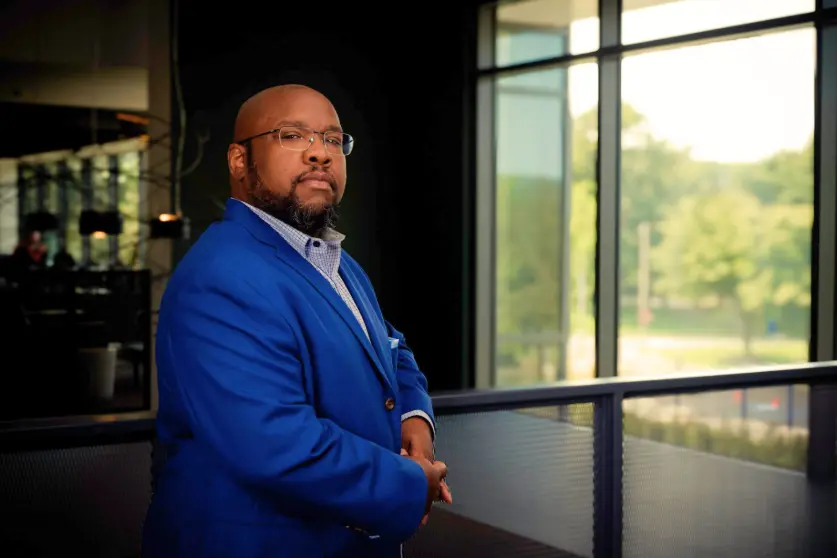
Former banking executive Endré Jarraux Walls is the founder and CEO of adapfin, a fintech building technology designed to help financial institutions modernize the systems that power their day-to-day operations.
The idea grew out of his own experience inside banking, where he saw banks and credit unions spending millions on legacy technology while relying on multiple outside vendors to keep up with changing customer expectations.
“I would go as far as to say that the banking industry as a whole is probably 10 to 15 years behind, technology-wise, from every other industry, including healthcare,” Walls told UrbanGeekz in a sit-down interview.
Walls believes much of the problem lies in the outdated infrastructure running behind the scenes. His company is developing a platform designed to bring more of those banking functions together, reduce reliance on multiple vendors, and give institutions greater control over how they build and launch new products.
Launching adapfin is the latest move in a career spanning technology, cybersecurity, operations and banking. But his path to the C-suite did not begin in a bank or a boardroom. It began at 17, when he took a job that, as he puts it, involved being “literally the guy who got the broken computer.”
Related Post: Black-Owned Fintech Company Launches $150M Loan Portfolio for Underserved Homeowners
From Broken Computers to the C-Suite
Walls had just graduated from high school and was not ready to go straight to college when his mother made it clear that staying home was not an option. “My mom, as our moms do, told me, ‘You got to do something, right? You can’t just veg around the house watching MTV,’” he recalled. So he got a job in technology as a hardware technician. His responsibilities were straightforward: he retrieved broken computers from employees’ desks, replaced them with working machines, and took the faulty equipment to someone else to repair. “That was literally my job,” he said. “I got paid to do that.”
By the age of 19, Walls had landed his first project management job, leading a team of 10 people working on an operating system upgrade at a petrochemical company with thousands of computers. The experience introduced him to managing people and helped set the direction for the rest of his career. He later became a network engineer, building infrastructure for companies including GE and traveling internationally for work. His career progressed quickly. By 29, just a decade after starting as the person collecting broken computers, Walls had secured his first C-suite position as chief technology officer for a health and human services organization operating across 15 states.
Stepping Into Executive Leadership
While serving as CTO, Walls decided to return to school. He says years of working had given him a different perspective on education and made him more prepared to take it seriously. He later completed an accelerated management program at Yale School of Management while continuing to lead the organization. From there, he remained in executive leadership, becoming CIO of a telecommunications company before joining Ricoh, the Japanese multinational technology company, as a managing partner. At Ricoh, he helped build a consulting organization that grew from zero to $500 million in two years. But the experience also brought one of the most difficult moments of his career.
A change in corporate direction led to layoffs, forcing Walls to tell employees they were losing their jobs for reasons that had nothing to do with their performance. “Calling people and telling them, ‘I’m not letting you go because your job performance was bad or anything that you did, just because someone else made a different decision,’ that was really hard,” he said. The experience made him reconsider what he wanted next and eventually led him toward a smaller organization and, ultimately, into banking.
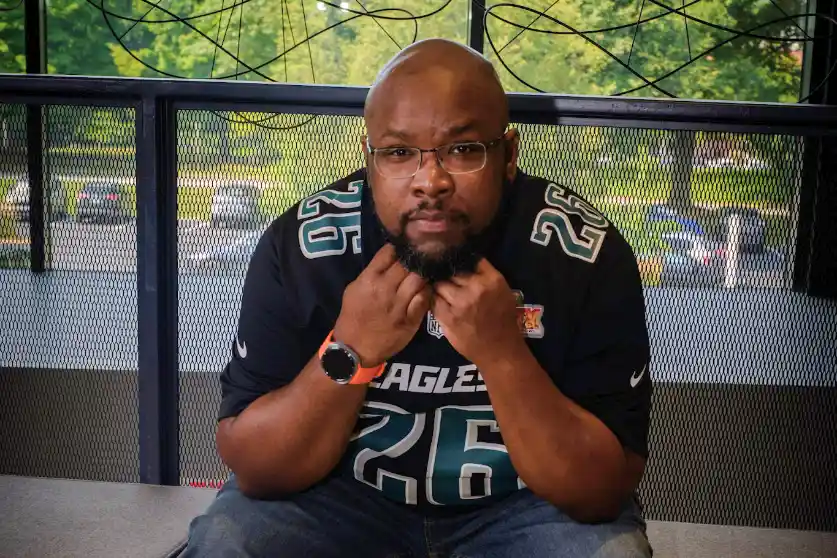
Endré Jarraux, CEO and Founder of adapfin and Avid Sports Fan
Related Post: Nigerian Fintech Daya Raises $2.4M Pre-Seed to Scale Stablecoin Payments Across Africa
Seeing the Problem From Inside Banking
Walls’ experience in regulated industries had largely centered on technology, security, and compliance, and those skills led him to work on the launch of T-Mobile Money in 2018. He helped develop the security and digital compliance program for the project, bringing experience from regulated enterprises and an understanding of how technology could improve compliance and operations. He later became chief information security officer at the bank that sponsored the project and, three and a half years later, was promoted to chief operating and technology officer.
Throughout his career, Walls says he has been drawn to the same challenge: figuring out how technology can improve an organization without replacing the people who make it work. “I found that my niche is figuring out how to leverage technology to enhance something,” he said. “… people always want to use technology to do work. I think that human beings do the most meaningful work and the technology should be used to accelerate and improve the quality of their work, not replace them.” It is a philosophy that now shapes his approach to adapfin and his views on artificial intelligence.
But banking also exposed Walls to what he believes is a deeper technology problem. Much of the industry’s infrastructure, he says, was built decades ago, often on mainframe systems that have continued to function well enough that banks had little incentive to replace them. “Up until like the last four or five years, you wouldn’t find a single banker who said that their mission was to be a good technology company,” Walls said. “Or to even have good technology. It was very rare that banks were worried about tech. They just wanted something that ran.”
Building Adapfin
Those experiences became the foundation for adapfin. Walls says he and his co-founders did not set out simply to build another piece of financial technology. Instead, they looked at the problems they had encountered during their own careers and asked how they could create a platform that addressed them together. The team includes executives with backgrounds in banking, security, operations and technology, and Walls says that firsthand experience shaped the company’s approach. “We fixed those three issues and it was important to us because we’ve all been in that seat,” he said. “I was a COO, our company’s COO was a COO, our chief security officer was a CISO in a bank. Our chief technology officer helped to build those platforms for Goldman and Barclays.”
The Three Core Issues
The first problem, Walls says, is the growing number of vendors financial institutions have to manage. Rather than requiring banks to build a stack of separate fintech services, adapfin is designed to bring more of those capabilities together. “You don’t have to have dozens of fintech vendors in order to leverage our platform,” he said. “Everything that you need is there for you already.” The second is product creation. Instead of waiting for a vendor to develop a new product, Walls says institutions should have more control over creating and launching their own offerings, while still moving through the necessary approval and regulatory processes.
The third issue is operational flexibility. Walls believes too much enterprise software requires employees to change established processes simply to fit the limitations of the technology. His view is that technology should adapt to the institution instead. “Our software is flexible,” he said. “You change it around the way that you want it so that it fits your operations instead of you having to train your staff on how to do what they know how to do every day differently because that’s all the software allows.”
For Walls, the mission also has a broader community dimension. Community banks and smaller financial institutions play an important role in supporting local businesses and borrowers, and he believes better technology could help them grow without losing that local focus. “We see this entire sort of ecosystem approach where we have an ability to help community institutions grow because that helps communities grow,” he said. “We can make the perfect product and, oh, by the way, we can solve for these different issues that we know institutions have because we lived it.”
Leaving the C-Suite Behind
Building a company, however, has brought Walls a different kind of challenge. After years of working inside established organizations and leading large teams, becoming a founder meant accepting that having a vision does not necessarily mean controlling exactly how that vision develops. Over the last two years, he says, adapfin’s original idea has changed significantly as the market evolved and the company adjusted its approach.
Walls says some of his biggest career gains have come from making decisions that pushed him outside his comfort zone. He recalls advice from a mentor that has stayed with him throughout his career: “If you’re not challenging yourself on a regular basis, then you’re not growing.” Walls says that idea changed how he thinks about professional growth. “You can learn and grow. You can make moves and grow,” he said. “But if you don’t challenge yourself, that’s where the real growth happens.”
Another piece of advice came from his grandmother, whom he calls Nana. When Walls was in high school, he was nervous about moving into advanced placement and honors classes because he worried about whether he would be able to keep up. His grandmother gave him a line that he says did not fully make sense to him at the time. “She looked at me, and she said, ‘There isn’t a waterfall anywhere that you get to with a paved road,’” he recalled. As he got older, the meaning became clearer. “You get to these natural waterfalls, it’s the most beautiful thing you’d ever seen, right? But you had to hike there. It wasn’t comfortable, it wasn’t easy to get there because the best things aren’t.”
Related Post: Nigeria’s Payaza Clears Record Debt in African Fintech Milestone
From Engineer to CEO
Walls’ journey into executive leadership also came with challenges that he says are familiar to many Black professionals moving through corporate environments. He remembers hearing comments about how “articulate” he was and questioning what those comments suggested about the expectations people had of him. He also spoke about learning to code-switch and the tension between wanting to bring his full, authentic self into the boardroom and understanding how corporate spaces often operate.
One question from an executive has remained with him. Walls says he was once asked what made him think he was capable of being a CEO. He did not interpret the question as an inquiry about his vision or leadership strategy, but as a challenge to his legitimacy. “The question hurt me to my core, but it gave me fuel,” he said. It also led him to think differently about what he would tell other executives who may see the C-suite as the final stage of their careers.
What’s Next for Adapfin
Walls is now focused on conversations with community banks, including institutions in urban areas that he believes could benefit from the platform adapfin is building. For him, improving the economics of those institutions could have an impact beyond banking itself by allowing more capital to flow toward the small businesses and communities they serve. “That means better economics for those banks, more money for them to put out there for loans and the financing that we need to start small businesses,” he said. “I think that’s important for the community, not just our community, but every community frankly, because small businesses drive the American economy whether people realize it or not.”
He is also interested in connecting with Black bankers and investors who may be considering building or investing in financial institutions but see the path to profitability as too difficult. Walls believes access to experienced people who are willing to offer honest advice can be just as valuable as access to capital. “Sometimes the hardest thing to get access to is an expert who will tell you the truth,” he said. “I’m willing to talk to anyone who’s interested in banking, who isn’t a bank and wants to improve things, or who is a high-order investor who’s thinking about starting one and feels like it’s a little prohibitive.”
“There isn’t a waterfall anywhere that you get to with a paved road,” his grandmother once told him. Years later, as he builds adapfin and takes on another unfamiliar challenge, that advice still seems to guide him.
To learn more about adapfin or start a conversation with the team, visit adapfin.com.