
5 Ways to Support Brain Health Before Symptoms Appear
October 1, 2026
Americans Are Moving Less, With Texas and Florida Leading the Shift
October 1, 2026
In late October 2024, Apple made 16GB the standard memory configuration across every Mac it sold. The move was widely read as preparation for Apple Intelligence, which needed more memory than the old 8GB baseline could spare.
Apple did it without raising prices. For the first time in the company’s history, the entry-level Mac and the expensive one had the same amount of memory.
On March 11 of this year, Apple launched the MacBook Neo at $599. It has 8GB of memory, a 256GB drive, and an A18 Pro chip, the processor from the iPhone 16 Pro. Apple markets it as built for artificial intelligence.
Sixteen months separate those two decisions. In between, data center demand for memory chips repriced the entire supply chain.
Manufacturers redirected production toward the high-bandwidth memory used in AI servers, and according to TrendForce, contract prices for conventional memory rose 90% to 95% in the first quarter of 2026 alone, with memory used in desktops and laptops expected to at least double in that quarter.
To measure what that did to the shelf, SmartScout analyzed Amazon U.S. marketplace data retrieved on Sept. 17, 2026: estimated revenue and year-over-year growth across 19 computing and consumer electronics categories, 300 Apple laptop listings, brand-level revenue share in laptops, buy box price histories for individual products, and Amazon search volume. Full methodology appears at the end of this article.
Related Post: Apple TV Expands to an Additional 40 African Countries
Almost Half of Apple’s Amazon Laptop Volume Is Now 8GB
Smart Scout tracked 300 Apple laptop listings in the Amazon U.S. traditional laptops subcategory, accounting for $114,945,776 in monthly revenue and 105,142 units.
Sorted by the memory configuration stated in each listing, 45.6% of units now ship with 8GB. Another 39.4% ship with 16GB. Configurations of 32GB and above account for 2.4% of units between them.
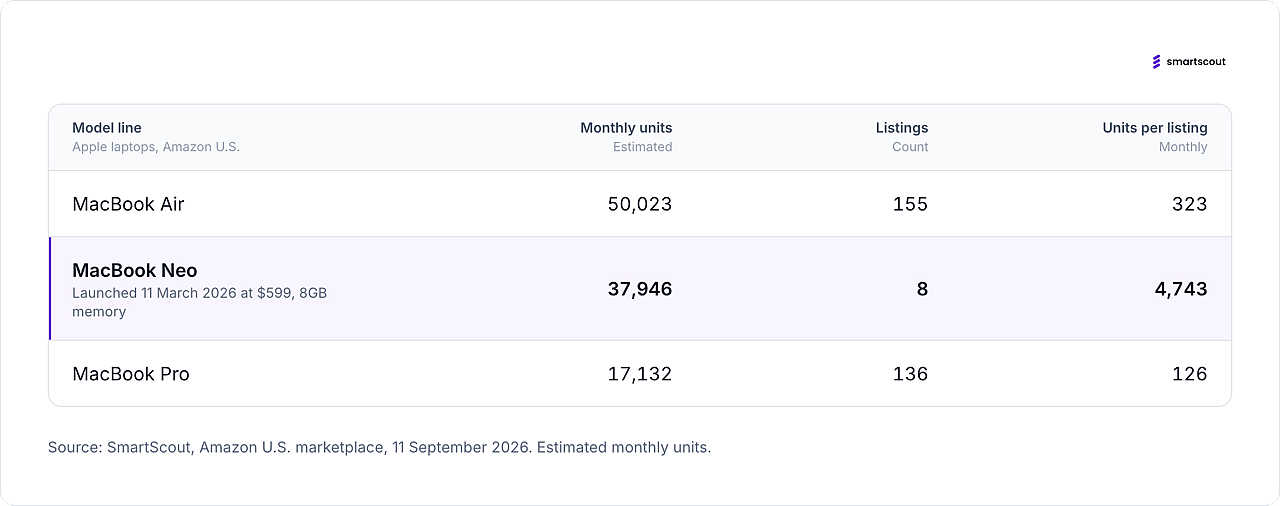
The MacBook Neo is doing that on its own. It generates $27,742,797 a month, 24.1% of Apple’s Amazon laptop revenue and 36.1% of its units, from eight listings. The MacBook Air needs 155 listings to produce 47.6% of units. The best-selling single MacBook Neo configuration moves 8,169 units per month compared to 6,348 for the best-selling MacBook Air.
A machine that did not exist in February is now a third of Apple’s laptop volume on the largest retail channel in the United States.
Related Post: Beyond Code Collective Launches Coding Series With Support From Apple
Two Ways To Send a Shopper the Bill
Every device maker facing higher memory costs has two levers. Raise the price, or reduce what goes in the box. Which lever a company pulls depends on whether it has a configuration to cut and a margin to protect.
Laptop makers have both. A laptop has a memory tier, a storage tier and a processor tier, and the maker can move any of them without changing the name on the lid. So on Amazon U.S., laptop revenue grew 19% year over year, a modest figure against the 162% increase in prices in the computer memory aisle. The adjustment happened inside the specification instead.
Console makers have neither. A PlayStation 5 is a PlayStation 5. There is no 8GB version to sell instead, and consoles carry thin hardware margins by design because the money is made on software. Microsoft said as much when it raised Xbox prices by as much as $150, stating that storage and memory costs had more than doubled since the previous autumn and that consoles are not sold with enough margin to absorb that increase.
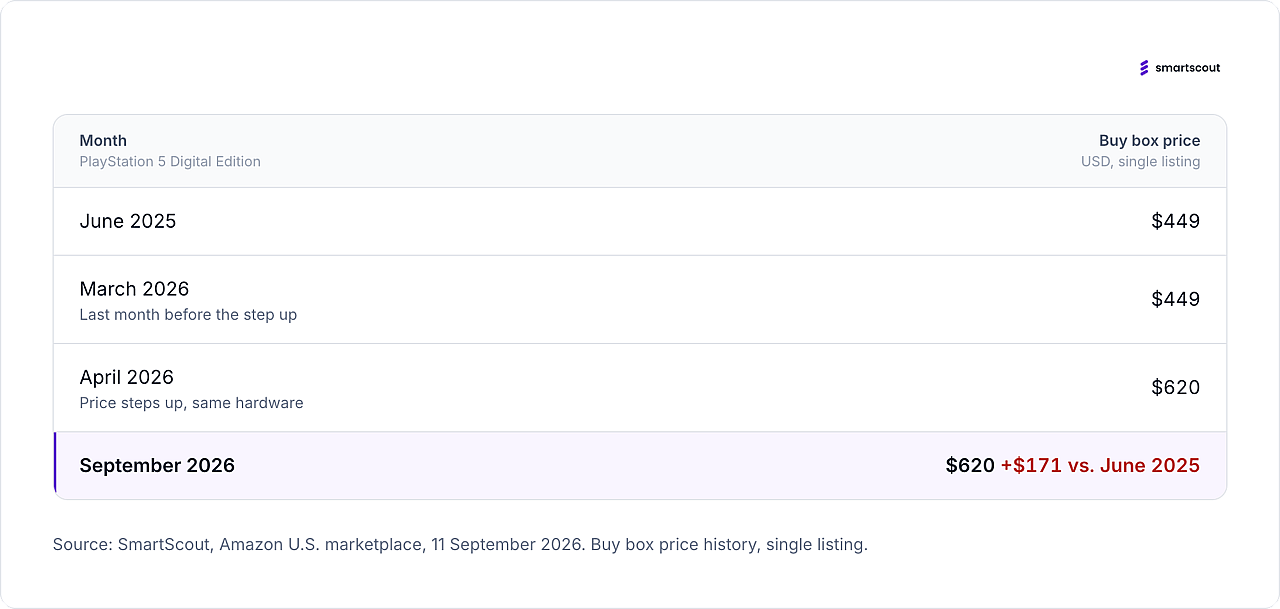
The result is visible in the price history. A PlayStation 5 Digital Edition held a “buy box” price of $448.50 in June 2025 and $499 from September through March. In April 2026, it rose to $598. By August, it averaged $623. The machine did not change. PlayStation 5 console revenue on Amazon is up 56% year over year, and Xbox Series X and S revenue is up the same 56%.
A console buyer pays more for the same machine. A laptop buyer pays a little more for a smaller machine. Both are paying the memory bill.
The Further a Category Sits From a Memory Chip, the Less It Moves
Ranking Amazon U.S. categories by year-over-year revenue growth produces an unusually clean gradient.
Categories where the memory chip is the product saw the steepest price increases. Computer memory rose 162%, while external solid-state drives climbed 90%. Memory cards increased 64%, internal solid-state drives rose 63%, and flash drives gained 35%. The data storage department as a whole is up 91%.
Products where memory makes up a large share of the bill of materials also saw increases, but they were smaller. Consoles rose 56%, graphics cards gained 41%, laptops increased 19%, tablets climbed 17%, and processors rose 11%.
Meanwhile, products that contain little or no memory saw minimal movement or declined. Computer monitors rose 14%, networking products gained 9%, and tablet accessories increased 8%. Power supplies were flat, while cooling fell 10%, motherboards dropped 13%, and optical drives declined 24%.
Motherboards and power supplies are the tell. Those are the parts you buy at the same time as memory. Both categories are flat or falling while memory climbs, which is what happens when people stop building computers.
Related Post: Google Unveils AI Edge Eloquent, an Offline Dictation App Powered by AI
Shoppers Are Walking Down the Memory Ladder
Search behavior on Amazon confirms that buyers are adjusting their own expectations rather than paying up.
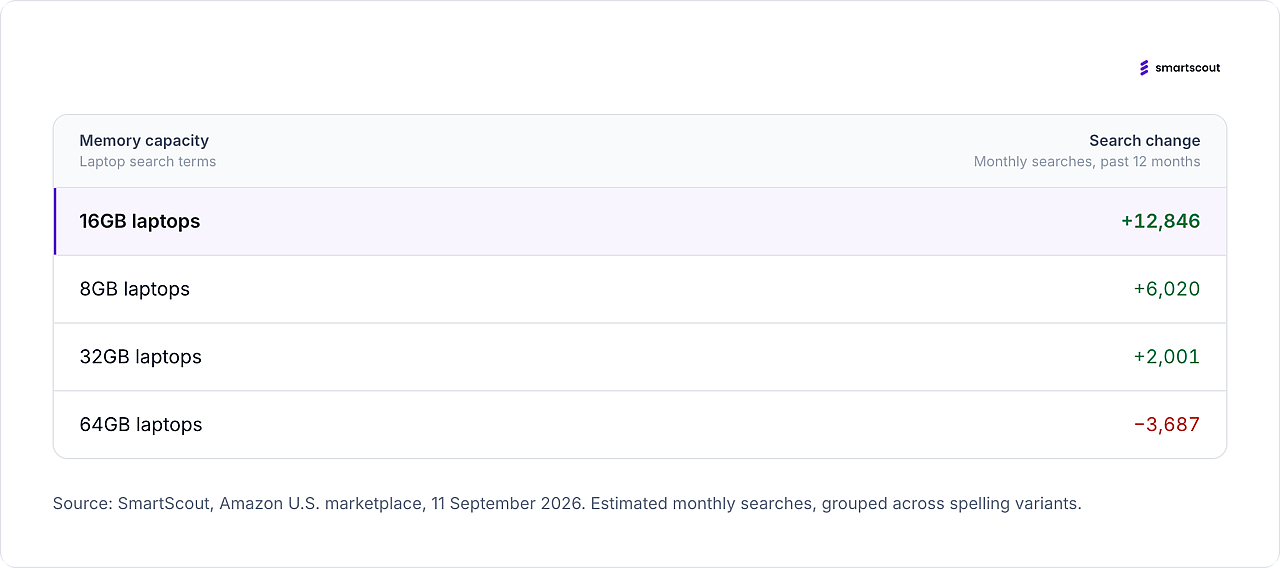
Grouping laptop memory searches by capacity, the bottom rungs are growing, and the top rung is shrinking. Searches for 8GB laptops are up roughly 6,000 over 12 months and gained about 3,500 in the last month alone. Demand for 16GB laptops has increased by roughly 12,800 searches. Meanwhile, 32GB laptop searches are up about 2,000 but fell last month. Interest in 64GB laptops declined by about 3,700 searches over the year.
The secondhand market is inflecting at the same time. Searches for refurbished laptops stand at 44,532 per month, up 9,109 in the last three months after being flat the year before. “Refurbished laptops clearance sale” has gone from almost nothing to 15,558 searches a month. “Certified refurbished laptops” and “refurbished laptop clearance” both appeared from a standing start in the last twelve months.
People are not canceling the purchase. They are buying “less” computer, or buying somebody else’s.
The Squeeze Is Consolidating the Market
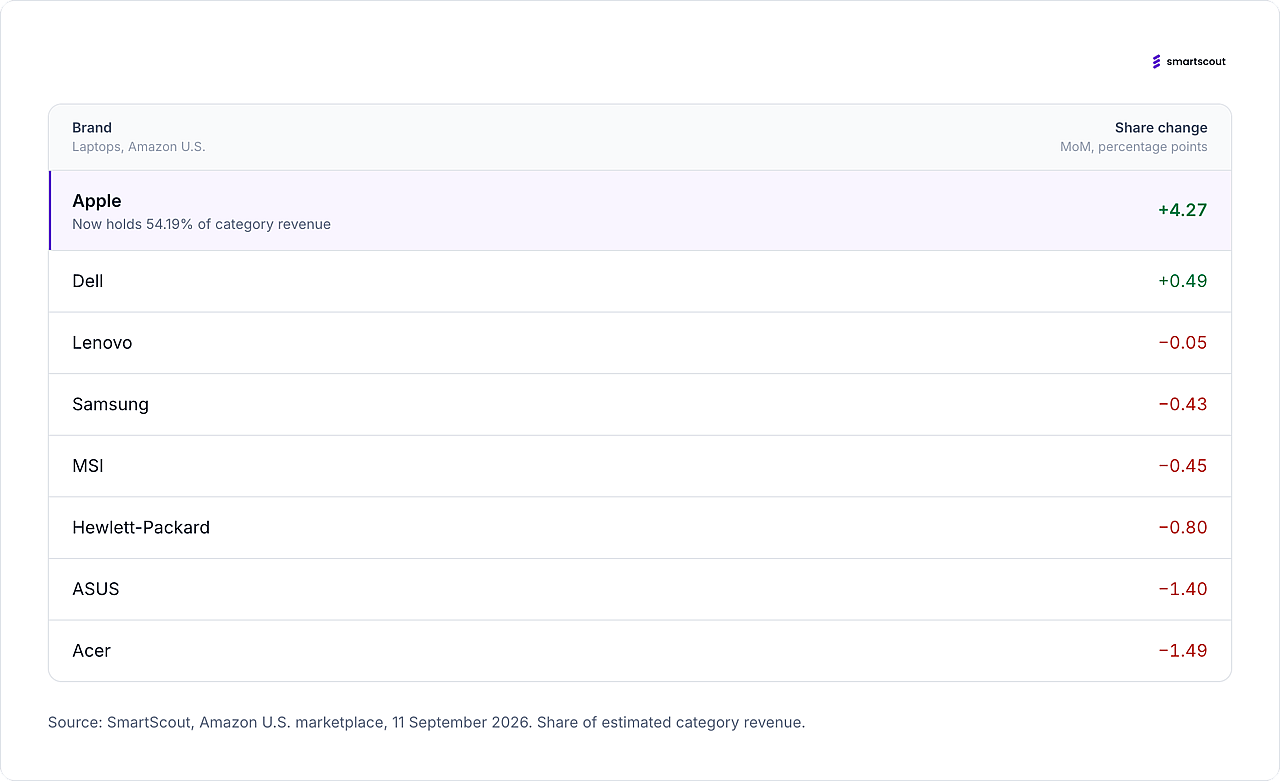
Apple now holds 54.19% of Amazon U.S. laptop revenue, up 4.27 points month over month, and accounts for 50.6% of all advertising spend in the category. It gained that share in the same period it raised prices on Macs and iPads by as much as 25%, citing memory costs.
The brands that lost ground are the ones that buy memory and storage on the open market and sell into the enthusiast segment. Acer fell 1.49 points and lost 3,460 units. ASUS fell 1.40 points. Hewlett-Packard fell 0.80. MSI, whose average selling price of $2,520 is the highest of any volume brand in the category, fell 0.45 points and lost 594 units. Samsung fell 0.43 points and lost 3,211 units.
Component scarcity rewards whoever has the longest contracts and the most leverage with three suppliers. On Amazon, that is currently Apple.
Methodology
This analysis is based on Amazon U.S. marketplace data from Smart Scout, retrieved on Sept. 17, 2026. Smart Scout estimates revenue and unit volume from sales rank, offer and pricing data across the Amazon catalog.
Category figures are the year-over-year change in estimated monthly revenue for named Amazon subcategories, comparing the most recent month of data with the same month a year earlier. The categories referenced are computer memory, internal solid state drives, external solid state drives, memory cards, graphics cards, processors, motherboards, internal power supplies, network cards, internal optical drives, computer monitors, tablets, traditional laptops, PlayStation 5 consoles, and Xbox Series X and S consoles.
The Apple configuration analysis covers 300 Apple listings in the traditional laptops subcategory, together accounting for $109,984,689 in estimated monthly revenue and 99,707 units. The memory tier was parsed from the unified memory figure stated in each listing title. The tier breakdown is reported across the $98,582,014 in monthly revenue and 79,327 units for which a figure is stated.
Brand figures are each brand’s share of estimated revenue within the traditional laptops subcategory. Unit changes are measured month over month.
Price histories are monthly buy box prices for single named listings, not category averages.
Search figures are Smart Scout estimates of monthly Amazon search volume in the United States, grouped across spelling variants, so that “16GB ram laptop” and “16 GB ram laptop” are counted together. Growth windows are trailing periods ending September 2026.
Marketplace figures are modeled estimates rather than numbers reported by Amazon, and they move as new data arrives. All figures describe the marketplace as of the retrieval date above. Industry pricing context is drawn from company announcements and analyst research, cited inline.
Written By: Scott Needham for Smart Scout